30 November 2008

Creamy Brussels Sprout Soup with Shallots and Roasted Potatoes

I lived in a tiny studio apartment my last years of college. Fortunately, the cramped quarters had a good-sized refrigerator and stove so I could cook real meals. I made use of everything in those days, and I still do, but once in a while, I forget I've got something on hand and it goes to waste.

Not anymore. Some of my favorite grocery store staples - low-fat cream cheese, for example - have nearly doubled in price in the last year.

The mortgage was paid long ago and my economic situation is vastly improved over 23 years ago. But somehow it seems wrong to let anything go to waste when it costs so dearly and so many people are without ample food.

I had about three cups of sautéed Brussels sprouts left over from Thanksgiving dinner, some shallots and a half-cup or so of roasted potatoes. These, I thought, would provide the basis for Brussels sprouts soup. I have become enamored of the tiny bowls of soup served by chefs these days and was determined to create something comparable.

Creamy Brussels Sprouts Soup with Shallots and Roasted Potatoes

2 Tablespoons extra virgin olive oil
1 tablespoon butter
3 cups Brussels sprouts, washed, trimmed, outer leaves removed, sliced in half
2 shallots, peeled and chopped
5 cups chicken broth*
1/2 cup previously roasted potatoes
1 small onion, peel and chopped
dash freshly ground pepper
dash fleur de sel
dash nutmeg
1/3 cup half-and-half or cream

Pour olive oil into a large skillet, adding butter. Sauté the sprouts and shallots for 8-10 minutes under medium heat, stirring frequently. Add one cup of broth, bring to a boil and cover, lowering heat. Add onions. Allow to simmer for 10-15 minutes until broth is reduced. Carefully transfer to stockpot, adding potatoes and remainder of broth. Cook under low heat for another 10 minutes, adding nutmeg and salt and pepper (taste frequently; I used about 8 spoons). Turn off heat and allow to cool 15 minutes. Then transfer soup to food process or blender. Puree. (I pureed one half, set it aside and then pureed the other half). Return to stock pot and add cream, re-heating under low heat.

*My soup broth was half chicken broth, half bouillon from garlic-and-olive-oil cubes I bought at FranPrix last year. I always add what ever cheese rind I have on hand, and discard before pureeing.

I recommend grating cheese on top and adding croutons before serving. I did not do that as I was too anxious to try the soup. It was soothing, always a good thing on the tail end of a long weekend.

What did you do with leftovers this weekend?

28 November 2008

Chive Crackers with Brie and Chestnut Butter

Under normal circumstances, I am suspicious of food items that purport to be created to be "paired with" another food item. Having worked for an advertising agency (and being a fan of "Mad Men"), I know this is a marketing gimmick. It works, though.

These chive crackers (green, yet!) grabbed my attention a few weeks ago at Fromagination on Madison's capital square. "For Brie cheese," said the box. (Really. Boxes talk to me all the time.)

"Hmm...just right for one of our finger-food nights," I thought as I nabbed a pack and tucked it into my chock-full-of-cheese basket.

Brie is one of those acquired tastes for me. It was not part of my diet growing up, and even when I went off to college, Camembert on a baguette slice was the cocktail party food of choice.

I could not get into Brie. Maybe there is a reason for that.

My father's maternal line, as far as I can determine, came from Melun, a city south of Paris that is know for its Brie cheese. The family name in the U.S. is LaBrie, which is one of those "dit" names that started out as something else, but got changed upon arrival in the New World, or perhaps soon after.

Family history records are not very extensive on my father's side, but it looks like the orginal name was Migneault or or some variation thereof, and became LaBrie somewhere on this side of the Atlantic. Perhaps the orginal immigrant was a cheesemaker who acquired a nickname. Or perhaps, he was not a cheesemaker. Maybe he acquired a nickname that referred to his geographic roots, not his occupation - as in cheesehead.

Whatever. It's a lovely name, and I like the fact that it is feminine, although Brie is actually masculine. Brie is a feminine cheese, if you ask me, mild, earthy and comforting.

I know this now. But perhaps I once had a genetic loathing for something my ancestors grew tired of...

Now I have an appreciation for Brie, especially when paired with something sweet. The chive crackers were perfect, but I thought it needed something more. So I scrounged around in the pantry and found a jar of Bonne Mamam chestnut spread. I plopped a dollop of that atop the schmear of Brie that sat atop the chive cracker.

I was a little nervous as I slipped it into my mouth. But, oh, the taste! If France can be reduced into a cracker with two toppings, this was it! I was immediately transported back to Montcuq and its chestnut trees. Or Paris.

Merde! This is good, I told my husband.

And he agreed.

I'll be featuring a favorite recipe using Brie in a day or two. Do you like it? How do you eat it?

27 November 2008

Cold Weather Breakfast, Part III: Savory Bread Pudding with Four Cheeses and Herbes de Provence

A festive day calls for a festive breakfast.

And a little ingenuity. I had a half boule of Italian bread from LaBrea Bakery and a cheese drawer that was filled to the brim. Did I mention a raving hunger?

I knew it would be a long time until the big dinner. Our menu included pork tenderloin with a cranberry glaze, herb-y oven-baked potatoes and Brussels sprouts with shallots and roasted walnuts - not terribly time-consuming, but not simple either. (I took lots of pictures but in the mad rush had my camera on the wrong setting. I look forward to seeing what you ate!)

You already know what pleasure I get from using what is on hand. Here's what I came up with:

Four Cheese Bread Pudding with Herbes de Provence

1 half boule of Italian or country-style bread, torn into 1-inch pieces
4 eggs
2 cups two-percent milk
1 cup sharp cheddar cheese, grated
1 cup gouda cheese, broken into chunks
1/3 cup Asiago or Parmesan, grated
2/3 cup swiss cheese
1/2 tablespoon minced onion
1 Tablespoon herbes de Provence
dash freshly ground pepper
pinch fleur de sel

Preheat oven to 375. Place bread chunks in large bowl. Beat eggs and milk in smaller bowl; pour into large bowl and set aside for five minutes. Once bread has absorbed the liquid, fold in cheese, onion, herbes and seasonings. Transfer to buttered casserole dish and place in oven. Bake for about 45 minutes, until top turns golden brown. Cool 10 minutes.

Four cheeses are essential for this dish. The cheddar is the base. The creamier cheeses balance the bite of sharp cheddar and the Asiago or Parmesan provides the accent. You can use any combination of cheeses for variety.

26 November 2008

A Reason to Give Thanks

I sometimes wonder what Grandma Annie would think of what I have written about her on this blog. Would she blush at her little bit of fame? Would she cringe? Or, would she scold me and then turn away with that secret smile on her face?

The latter, I like to think. Maybe I am wrong.

She certainly never sought any kind of fame, or even fortune. Her marriage was 100 years ago now, and in the early days of that marriage she lived next door to her in-laws and then a block away from her parents. Within 10 years of her marriage, she moved back into her parents' home, taking the downstairs flat, which had been a general store. She raised her four daughters there until 1930, when the building was converted into a stately home, close to the street on its south and west sides but with a spacious yard and garden on the north and east sides.

She never traveled farther than Chicago, to my knowledge, but she loved the bustle of the city and shopping at big old department stores like Marshall Fields. Her life centered around her home and family: Cooking, cleaning and sewing. Cooking especially. She was known for her quality baked goods, and quality they were: No one else knew how to make such wonderful rolls, cookies, breads, pies and cakes as Annie's, not even local bakeries. (Naturally, she loved other people's baking.)

Annie was a whiz with a sewing machine, too, and when she left school she worked for a time as an apprentice seamstress. She took aging garments and remodeled them, a skill that surely put her and her daughters in good stead during the Depression and World War II. She made aprons, tablecloths, napkins and hot pads out of sprigged or flowered cotton, often giving them as gifts. I still have an apple-print set she made for me when I moved out on my own. It's much too large for my table now, but I cherish it.

Tomorrow I will set my table with her goblets and her her sherbet bowls summoning her spirit as I prepare food for the people I love most.

I know she will be there. I need no empty seat to assure that.

May you and those you love find many reasons to give thanks tomorrow.

25 November 2008

Cold Weather Breakfast, Part II: Baked Oatmeal with Cinnamon and Brown Sugar

These days we awake to a cold dark world. The kitchen floor is cold under our slippers, but the coffee is warm and bracing and a cup or two we are almost ready to face the world.

The dark days of November call for a hearty, stick-to-your-ribs-style breakfast. My father believed oatmeal was the best choice on these mornings, and he often made it for me when I was a small child, lacing it with cinnamon and dotting it with raisins.

When I saw this baked oatmeal in the October issue of Midwest Living Magazine ("Wisconsin-style," said the headline), I thought I'd give it a try.

1 and 3/4 cups water
1 cup old-fashioned rolled oats
2/3 cup 2 percent or skim milk
2 eggs, lightly beaten
1/2 cup packed brown sugar (I used half Splenda)
1 teaspoon baking powder
1 teaspoon ground cinnamon
1/4 tsp. salt

Preheat oven to 350. Butter a medium-sized baking. In medium saucepan, bring water to boil, slowly adding oats. Stir. Return to boiling and reduce heat. Simmer, uncovered, for about 6 minutes for regular oats, or until most water is absorbed and the oats are tender.

Whisk milk and eggs in a small bowl. In another bowl, combine brown sugar, baking powder, cinnamon and 1/4 tsp. salt; stir into oatmeal. Fold in milk and egg mix. Pour oatmeal mixture into baking dish.

Bake, uncovered, in 350 degree oven 30-40 minutes, or until center is just set and sugar crust forms on top. Cool 30 minutes.

A bit bland, I thought, but reminiscent of those wonderful windmill cookies I loved as a kid. I'd add roasted walnuts and raisins next time. But hey, it stuck to my ribs.

And the taste really took me back. Not a bad way to start a new day.

24 November 2008

Cold Weather Breakfast, Part I: Tartines

I am a creature of routine. Each morning I stagger from bed, somehow manage to find my way to the kitchen, brew a cup of coffee and settle down with my laptop to read the morning papers, from Madison to San Francisco and several points in between. It takes me a good hour before I am awake enough to want breakfast.

But when I do it is a hardy breakfast I want.

More often than not, it is a tartine, an open faced sandwich loaded with some sort of egg, perhaps some cheese, a bit of sausage and perhaps a tomato, washed down with a small glass of milk and a small glass or orange juice. My goal is to get protein, a little fat, some fruit, and some whole grains.

I woke this morning to a fine layer of snow, not a bit unusual for this time of year. My breakfast was sourdough bread with a slick of butter and a thick slice of cheddar, broiled until the cheese was forming a shiny skin on top. That's when I know it's ready. I added a dollop of applesauce as a side.

You cannot go wrong with tartines. Another favorite is a bagel with salmon cream cheese, a tomato, some thin slivers of red onion and a few capers. I paid a whopping $15 for such a similar breakfast in the San Francisco Airport this summer. I like my own version much better.

This time of year, breakfast is really important to me. One year, not long after college, I baked bran muffins the Sunday before Thanksgiving. The next day they were hard as rocks. I was too poor to discard them, so I broke them into pieces (it took some work) and poured milk over them, creating a cereal of sorts. The milk softened the muffins and they made for a pretty good breakfast - possibly one of the best I've had (of my own creation, anyway).

Eating frugally often means being creative, and sometimes a little desperate.

What about you? What do you eat for breakfast? Have you ever salvaged a disaster as I did with my muffins? Tell us about it!

I'm truly curious.

22 November 2008

Acquired Tastes: The Blues and More

My cupboards and refrigerator are filled with items that were not part of Grandma Annie's kitchen, although my father bought them from time to time. Among those items are three staples: Red peppers, black olives and green cheese.

The diet of my youth was relatively bland: Meat and potatoes mostly, accented by salads, side vegetables and bread.

My mother avoided many of the foods my father liked, and so never served them to me and my siblings. Mushrooms are among them. She still wonders why we all love them, and assumes its a generational thing. Perhaps it is.

Garlic, my mother often reminds me, was something odd and foreign and exotic. I have this idea that World War II played a key role in brining garlic to small-town America. How ya gonna keep 'em down on the farm after they've eaten garlic, ya know?

Many of my acquired tastes were acquired when I cooked with my first college roommate, the American-born daughter of French parents, and explored Chicago restaurants with an early boyfriend (Steven, are you still a foodie?).

I learned to love Greek food, Yugoslavian wine and German beer, thanks to these and other college friends. We fancied ourselves gourmets and gourmands, cooking together, tring to outdo each other and exploring new ethnic restaurants. While our peers were expanding their record collections, we were buying small kitchen utensils that made exotic meal preparation easier along with mustards, jams, and exotic rice mixes.

Along the way, I also acquired a passion for red peppers (well documented on this blog) and black olives (a must for any tuna salad).

One of my favorite foods is blue cheese. I've used it in sweet dishes but mostly I enjoy it in salads.

At a recent tasting when a restaurant owner I knew was trying out a prospective chef, I tasted a simple salad of blue cheese, roasted walnuts and Granny Smith apple with an apple vinaigrette. It was really wonderful and elegant.

I bought some blue d'Auvergne in France and made a similar salad. This particular blue, made in the Massif Central area is creamier (and to my palate, gentler) than the typical blue cheese found in American supermarkets. I loved its subtle taste, and felt it better suited to warmer weather dishes (blue cheese is usually reserved for cold weather, at least in my life).

It's one more taste I have acquired. But I am curious. What tastes are new to your palate?

20 November 2008

Leave Takings and a Low-Sodium Soup Base

In recent weeks I've said a lot about the act of coming home, but I've said little about the sad process of leaving a place you love.

On days before departures - departures from France, usually - I feel jittery and empty and I take comfort in small household tasks. On our last night in the Lot Valley, I cobbled together a pot of soup, using a few leftover onions, a cube of chicken bouillon and mozzarella cheese. And lots of water, because the bouillon was salty (we drank water all night long, it seemed). I much prefer my old standby recipe or this cheesy variation I made last year in Paris.

I made garlic toast from the heel of a baguette and we ate the rest of my tarte tatin. We dragged out our last meal in the cozy yellow kitchen, and then walked out to the pool in the dusk to say our goodbyes to the big field and the vineyard and hills beyond it. (The day before, we had finally taken the road that wended its way up there, a one lane road, narrow and twisty like most mountain roads in France, praying we would not meet another vehicle.)

Then we tidied up the kitchen for the last time, and called it an early night. I was torn, wanting to stay and wanting to leave. Fortunately, two days in Paris lie ahead. And then we left all over again.

Leaving home for a trip is exciting. Leaving home and leaving my husband behind, as I did two weeks ago, tears me up until my car turns the corner toward the highway. Then I begin to relish my adventure and my alone-ness. I miss him terribly, of course, and I am always happy to come home again.

For those homecomings, I keep containers of soup base in the freezer, so I can create a quick pot of soup even when je suis fatigué.

My Favorite Low-Sodium Soup Base

2 large potatoes, washed and sliced
4 carrots, cut into chunks
1 bay leaf
3 medium onions, peeled and quartered
1 apple, quartered
1 teaspoon peppercorns
10 cups cold water

Combine all ingredients in large stockpot. Bring to a boil. Reduce heat and simmer for 30-60 minutes. Strain and discard solids. Makes eight cups. I split in half and freeze it if I'm not ready to make soup.

What soup would comfort you tonight?

16 November 2008

Stuffed Cheese Sandwiches with Roasted Red Pepper

In her later years, Grandma Annie seldom traveled but when she did, it was often to come to the aid of her oldest daughter who underwent a series of surgeries at mid-life. During those extended trips, my mother (a younger daughter) would haul us across the river to Annie's house in Frenchtown to "check things." These trips usually took place after school and they always seemed to be on gray November days.

We'd enter the cold, empty house, the day's mail in our hands, and quickly turn up the furnace. While my mother checked every room in the deep, narrow house, we children would huddle in the living room waiting for the heat to kick in. The furnace provided a gentle, lulling sound, a sort of comforting white noise that still soothes me today. I would eagerly sift through Annie's mail for the latest women's magazine so I could read the fiction. Those were the days before stories about orgasm and geriatric sex replaced quality short stories or novellas.

While the house was empty without Annie, her spirit always seemed to remain there as it lingered for many years after her death. Late afternoon, that time of deepening darkness, was a cozy time at the old house with the incandescent lights providing a yellow glow.

When Annie was in residence, this was the time she retreated to the kitchen to make soup, salad and sandwiches for the evening meal. I did this yesterday, as night fell, preparing a quick meal of cheese sandwiches and cole slaw. As always, Annie was with me, whispering those memories in my ear. I wonder what she would think of my concoctions?

Stuffed Cheese Sandwiches with Roasted Red Pepper, Tomato and Basil

8 slices of roasted red pepper
1 tablespoon extra-virgin olive oil
4 thick slices of sourdough or Italian bread
2 thicks slices of gouda or sharp cheddar cheese
4-6 slices tomato
4-8 basil leaves
butter

Coat the pepper slices with olive oil and roast in a 450-degree oven for 10-15 minutes. Set aside. Butter the bread lightly on all four sides, then layer with cheese, pepper, tomato and basil leaves. Melt butter in a skillet, and toast the sandwiches until both sides are golden brown.

Next time, I'll layer the sandwiches with sautéed onion slices for extra flavor.

I served this with cole slaw to which I added chopped cranberries and grated Granny Smith apple. I think an olive medley would have been a better choice.

15 November 2008

The Metals of November and the Chestnut Trees of Montcuq

At 4 p.m. today, the sky turned deep blue and the low-hanging sun shone amber on the nearly-bare branches. The park is littered with brown leaves now, and the colors of scarlet and persimmon are but a memory. The glorious foliage of fall is all too fleeting.

But I love the mellow sun and the gray days of November. Each month seems to have its colors, and the colors of November are the colors of metals, of steel gray skies, pewter afternoons, bronze sunsets and copper leaves.

Fall comes early to chestnut trees, and by the end of September, the chestnut tree in our side yard, so glorious with its candles of white in June, is nearly bare while the lawn is layered with brown leaves. We've been told the chestnut is not suited to our cold climate, but it has been in the yard forever and it will stay forever as far as my husband and I are concerned. We have found it rather ironic that since we have been making nearly annual pilgrimages to France, the tree has seemed healthier. The half a dozen blooms of years past have multiplied in early summer, and the tree keeps its leaves later in the fall.

It's as if our chestnut knows it has to perform, now that we've seen its cousins in Paris.

The chestnut trees in Montcuq, an old hillside town about a half hour southwest of Cahors lose their leaves early, it seems. While area south of the Lot River was nearly all green in late September, Montcuq's chestnut leaves had fallen to the ground. They crunched under our feet as we walked down the sloping boulevard near the center of town.

It was noon and the shops were shuttered. Save for three or four rather seedy characters lounging about the café, we were alone. One young woman, probably a worker at a nearby business, sat at a table with her lunch and read a book. I felt drawn to her; she reminded me of myself, a sometimes loner with a book.

We took a dozen or so photographs, preferring not to linger. Montcuq (make sure you pronounce the final "q" or you will be saying, "my derriere") is a lovely little town, but it made me sad on this particular Friday. We made our way home by the backroads, and had a late lunch of cheese, saucisson, olives, and bread.

I felt a sense of contentment that day, as I did this afternoon when the sky turned metallic. Despite the challenges ahead, life can be good. Cherish these moments.

Want to roast chestnuts for the holidays? Here's how!

13 November 2008

C'est Fromage! A Visit to Madison's Fromagination

Walking from my conference to my hotel each night, I passed an inviting little shop I'd wanted to explore last summer. I ran out of time then, but this week I'd pass the shop just before closing time. So, unabashed cheesehead that I am, I dodged inside drawn by the warm glow of possibilities.

The shop is Fromagination at 12 South Carroll Street. (I should note that the photo above was taken in France; I forgot my camera this trip.)

Fromagination is chock full of artisan cheese from Wisconsin's famous cheesemakers. Not wanting to make a choice, I purchased five "orphans," small wrapped odds and ends of cheese I will bring home to my husband for our Saturday night finger food tradition.

I found the staff friendly and knowledgeable, and they did not laugh as I oohed and ahed my way around the shop. Somehow, a bag of crackers and a fruit confit found their way into my bag, along with some candy for my sweet-toothed husband back home.

I have a difficult time restraining myself in food shops.

Moreover, I have still more difficult time passing by a food shop at the end of the day. There is something enticing about their cozy light against the darkening night and something enchanting about the practice of shopping for the evening meal on the way home. There's a comforting bit of serendipity involved in finding supper in a random way, of cobbling together a meal of what is available.

It's what I used to do on those long ago evenings when I lived here.

It makes me feel good to do it when I am back in town.

12 November 2008

A Chocolate Fix on a Foggy Night

November nights in Madison come early, especially during the annual spate of damp weather that inevitably arrives toward the middle of the month.

The walk between the hotel where I am staying and the hotel where my conference is located is about eight blocks, uphill on the way there and downhill on the way back. After two mornings of walking up hills I swear did not exist 20 years ago, I gave up and grabbed a Madison Metro bus this morning.

But my walk home at 6 p.m. is downhill and involves walking past many food shops, including a cheese shop which I will address in a later post.

I bought cheese, of course, as a means of countering the chocolate deluge I experience today, along with the rain. During my classes, every time a I turned around, there was chocolate. (Reminds me of graduate school, when one of my classmates was a chocolate buyer. Chris often brought chocolate treats to our ethics seminar.)

So when I brought my cheese bag home, what should spill out but three Dean & Deluca chocolates? A while later, a nice lady from housekeeping brought two squares of rich chocolates to my door.

How heavenly is that?

I'm blogging in my pajamas, I should mention here. And why not? It's cold and damp and the flannels makes me feel all cozy and comforted. Then there is the chocolate.

Oh, and the delectable chocolate confection above was purchased in France. It's a mousse-like thingamajig with a crispy layer on the bottom. Need I say more?

09 November 2008

Sweet Things: Old Habits Die hard

For a few days I am back in Madison, playing student again as I did only five months ago. During the day, I'll be concentrating on learning the role I can play in helping the economy, at least on a local basis.

I swear I lose 10 years every time I revisit this wonderful small but remarkably diverse city. I feel young again, walking the same streets I walked as a student, revisiting my old haunts. Was it only 20-odd years ago?

For many of my years here, I lived a few blocks off State Street. During the years I did not, I used that trendy little thoroughfare to reach my downtown office. My standard practice was to pop into a State Street bakery for a croissant or a brioche. Those were, of course, the days when I could comfortably eat sweets without assuming the girth of an entire Panzer division (is anyone out there familiar with just how large that would be?).

The photo above was taken in France. If I look hard enough this week, I'm sure I'll locate a bakery with comparable offerings. (Oh, how I miss the Ovens of Brittany on State Street!)

The test will be whether I can resist them or not. Save for a chocolate mousse-y thing, cream puffs, tarte tatin and a Jesuite, I was pretty good in France. For every whim I gave in to there was at least one more that I resisted.

How about you?

08 November 2008

Low-Carb, Crustless Chocolate Pumpkin Pie


Note: I am on the road for a few days and will return on Friday. The recipe below and the accompanying post are from three weeks ago.

From October 20: The act of coming home is the greatest small joy I know. So it has been since I was a child.

When we lived on Main Street all those decades ago, I would often come home at 3:15 on Indian Summer afternoons to find my mother hanging laundry to dry in our vast backyard, or removing a batch of cookies from the oven in the sunny yellow kitchen.

She was young and vigorous and full of life then. I so vividly remember finding her in the back yard on a particular balmy fall afternoon, romping with my baby brother on a blanket. We have photographs of that afternoon, and it remains memorable to me because my mother had been to the drugstore down the street and the market, and had returned with a pumpkin, a bag of chocolate, and two eye masks, one black and one turquoise.

“Halloween is coming, and we’re getting ready,” she told me, and I was delighted. At six, I was just developing an idea of the yearly round and what it meant as the seasons shifted and were marked with rituals and celebrations.

On this day and others like it, the inside front door of our home would remain open, letting in the cool autumn air as the sun slipped down into the west and the shadows of dusk set in. I can still hear the sound of early-evening traffic outside, and the clanging of pots and pans as my mother prepared supper. Our Craftsman bungalow was small and cozy and no room was any great distance from another. I still like this proximity in a home.

These days, I return home much later, and my routine is different: Get the mail, check the e-mail and phone messages, change into jeans, and think about supper. In cool seasons, I turn up the furnace, and in warm weather, I open the windows.

One thing has not changed: I want a snack to tide me over until supper, which is eaten rather late at our house, at least by American standards.

Lately, I’ve been thinking of ways to pair pumpkin with chocolate. Since it’s gray and blustery today; I don’t want to go out. So I used what I had on hand to make this crustless, low-carb Chocolate Pumpkin Pie.

1/2 cup low-carb baking mix
2/3 cup sugar (I used a sugar-Splenda blend)
½ teaspoon cinnamon
dash pumpkin pie spice
dash salt
½ cup melted unsweetened chocolate, cooled, or chocolate syrup
1/2 cup lite sour cream
2/3 cup canned pumpkin
2 eggs, beaten
1 teaspoon vanilla

Pre-heat oven to 350. Blend dry ingredients in large bowl and set aside. In a second bowl, blend chocolate syrup or melted chocolate with sour cream, pumpkin, eggs and vanilla. Gradually fold into dry mix. When mixture is smooth, pour into greased pie plate or square baking dish and bake for 45 minutes until the pie is firm, but not hard. Chill before topping with cream cheese frosting.

A day later, the dessert is firm and flavorful, and tastes richer than it did a few hours after I made it. You may have to adjust the sugar, depending upon our preference. I like a dessert that is not too sweet.

06 November 2008

A Season of Gratitude

There's no way of sugarcoating it: I've been feeling pretty bad lately. A case of the post-trip letdown, I guess.

Part of the problem was that parts of the presidential campaign had taken a turn I did not agree with. I was disappointed. And I was really, really tired of robo calls and television ads and circulars and flyers that hit my mailbox in a barrage.

I did not have the heart to visit my own blog, let alone anyone else's site. For that I apologize. I made a wonderful dessert, wrote a post, took a photo and refused to upload it.

I was dispirited.

All that changed Tuesday night when the election ended. We had a gracious speech from a candidate who defended his opponent in what was perhaps his finest moment on the campaign trail. We had an uplifting speech from the candidate who emerged victorious. We had faces of joy and hope and every color and every background gathered together in one place: Grant Park.

What a contrast to 40 years ago! The words "The whole world is watching" kept echoing through my brain. In 1968, Grant Park was the scene of violent riots at the Democratic Convention. Now it was the scene of victory.

The whole world is watching. We have overcome. Yes, we can.

It doesn't matter which party's ideology you adhere to, it really doesn't. What matters is that we have had a shining moment, and we may - if all goes well - have a brighter future. I'm not talking about the economy, but I am talking about the idea of cohesiveness, of working together for a greater good. Our shining moment must transcend party lines and ideological differences. And racial barriers.

I hope we move forward in a bipartisan manner. Because the whole world is watching now.

My husband and I are longtime media junkies. I started out as a reporter, and specialized in politics for a time, on both a local and national level. He started out as a photographer. That's how we met. We stay up late every election night. We suffer a letdown after Election Day, no matter which candidate wins.

This year, the letdown began before the election. Every night we would come home to 5-6 robo calls and an equal number of campaign mailers. Enough! Let's move on now.

And the photo? It was taken five weeks ago in Paris. I thought it had a celebratory look to it. As I said, no matter how you voted, we can all celebrate the removal of a barrier.

02 November 2008

Paris on a Budget

We've decided we probably won't make it back to France in calendar 2009. For one thing, we've got some home repairs and upgrades next year, and for another, I feel a bit guilty spending the money.

But we will return for at least a week sometime in the next 18 months. We know how to do Paris on a very small budget.

When my husband and I look back on our trips, the moments we cherish most are those that cost us very little in the way of financial outlay.

On a warm spring May Day four years ago, our favorite moment came when we fed pigeons in Place Paul Langevin in the Latin Quarter. I had a half-bag of cashews in my purse, and we enjoy teasing the ubiquitous critters while children played nearby in the sun-dappled little square not far from the Pantheon.

In 2007, an afternoon in Musee Carnavalet on a rainy afternoon and a visit to Square Georges Cain provided us with an equally low-cost and enjoyable moment on our last day in Paris.

We've found great pleasure simply exploring and lingering in the many gardens in Paris. We even enjoyed a wet walk along the Seine one Sunday afternoon when buses were infrequent.

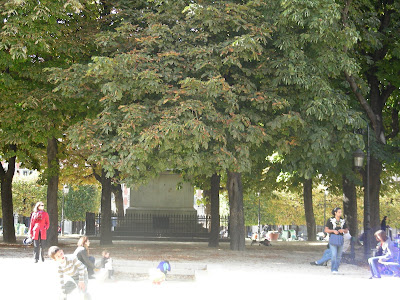
Recently we found pure joy in the Places des Vosges (above), just watching children play.

You can enjoy Paris on very little money indeed, I assured a reader who recently e-mailed me.

We've all got favorite tips, but here are a few of mine.

• Choose a value hotel. They abound in Paris. I find hotels on Tripadvisor, and have yet to go wrong that way. Expect a small room. You can adjust for a few days or even a week. You'll do a lot of walking as soon as you step outside the hotel.

• Make sure you have a mini bar in the room. Mini bar prices are often very reasonable when compared to those in snack shops and cafés. Your body clock will be off, and you may get hungry at odd hours.

• Fill up at the hotel breakfast, if it is reasonably priced, or buy a croissant from a bakery.

• If you will be in Paris for a week, rent a studio apartment. Most have microwaves and many have stovetops. Some even have ovens and all have coffeemakers. In 2007, we ate well for two weeks with just a stovetop and microwave.

• Shop for food basics at Ed l'Epicier, FranPrix or LeaderPrice. I found prices had gone up a bit from 2007, but they were still reasonable.

• Buy a carnet and use it to ride the Paris bus system. You will see a lot, observe real Parisians close up and not have to worry too much about pick pockets on the Metro. You can use public transport to get to and from Charles de Gaulle airport.

• Check out the city's free museums and sites. We thoroughly enjoyed Carnavalet and the Crypts. There are other freebies to enjoy.

• Walk. Explore hidden spaces. In my book, they - not the well-known monuments and open spaces which teem with tourists - are the true essence of Paris.

• Consider cafés and cafeterias located in one of the city's train stations. I found Le Train Bleu a bit steep, so we ate at the cafeteria just below and enjoyed a pretty darned good meal for a fraction of the cost of the fancy lady upstairs.

• Looking for entertainment? We chanced upon a string ensemble on Oct. 4 at the Place des Vosges (below). The music was sweeter than anything I'd pay for - it was spirited and spontaneous.

I'd love to hear your favorite tips for traveling anywhere and not spending a bundle.